
Children’s Eyecare
Comprehensive eye examinations for accurate prescriptions and healthy vision.
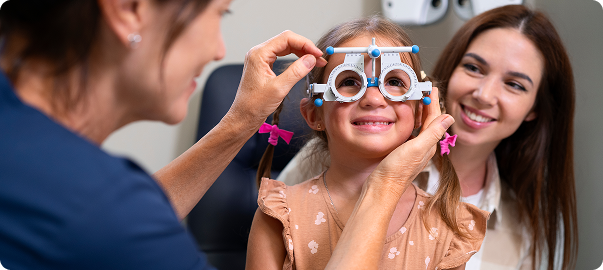
Children’s eyecare focuses on identifying and treating vision issues during the “critical period” of visual development (birth to age 8). Since children often assume their vision is normal even if it is blurred, regular professional checks are vital for early detection and intervention.
Common Tests for Children
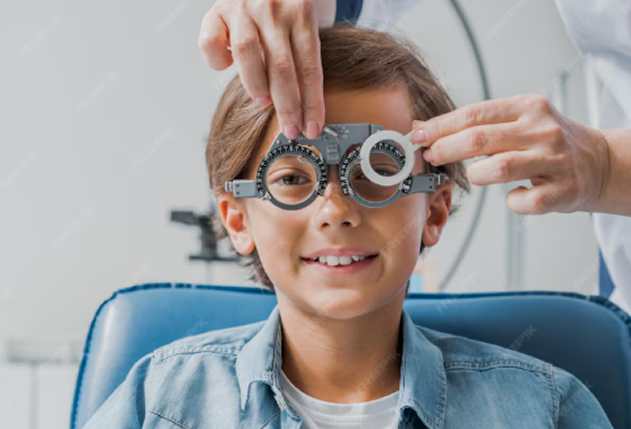
Optometrists use specialized, child-friendly techniques that do not require the child to read or speak:
- Picture & Symbol Charts: Instead of the standard Snellen chart, younger children use Patti Pics or Kay’s pictures to measure clarity.
- Red Reflex & Pupil Tests: Simple light-based checks to screen for cataracts or rare tumours.
- Retinoscopy: The optometrist uses a handheld light (retinoscope) to see how light reflects off the back of the eye, allowing them to determine a prescription accurately without the child saying a word.
- Binocular Vision Assessment: Checks how well the eyes work together as a team, identifying "hidden" squints or tracking issues.
- Cycloplegic Drops: Often used to temporarily relax the eye's focusing muscles and dilate the pupils for a more precise internal health check.
Key Conditions Monitored
- Amblyopia (Lazy Eye): Reduced vision in one eye, often caused by a squint or a significant difference in prescription between the two eyes.
- Strabismus (Squint): When the eyes point in different directions.
- Myopia (Short-sightedness): Increasingly common in children; many practices now offer Myopia Management (special lenses or drops) to slow its progression.
UK NHS Entitlement
- Free Eye Tests: All children under 16 (or under 19 in full-time education) are entitled to a free NHS sight test.
- Optical Vouchers: If a child needs glasses, the NHS provides a voucher to help cover the cost, which often makes standard frames and lenses free.
When to Book an Appointment
You should seek an eye exam if you notice:
- Physical signs: One eye turning in or out, frequent eye rubbing, or watery eyes.
- Behavioural signs: Sitting very close to the TV, tilting the head to see, or "clumsiness."
- Academic signs: Losing their place while reading or a sudden drop in school performance.
Find Your Perfect Pair of Glasses Today
Convenient, fast, and secure online booking for eye tests, hearing checks, and consultations.