

Contact Lenses
Comprehensive eye examinations for accurate prescriptions and healthy vision.
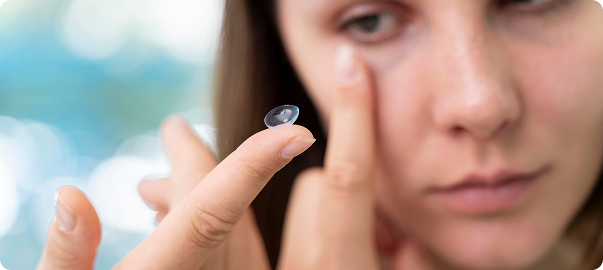
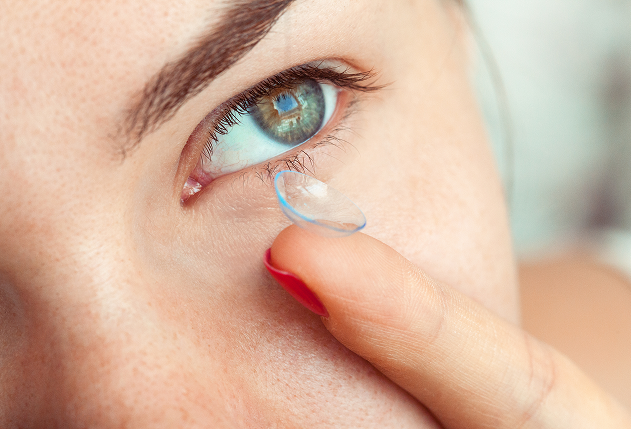
Contact lenses are thin, curved medical devices placed directly on the eye’s tear film to correct vision or for cosmetic purposes. They offer benefits like a wider field of vision, better suitability for active lifestyles, and no fogging compared to glasses.
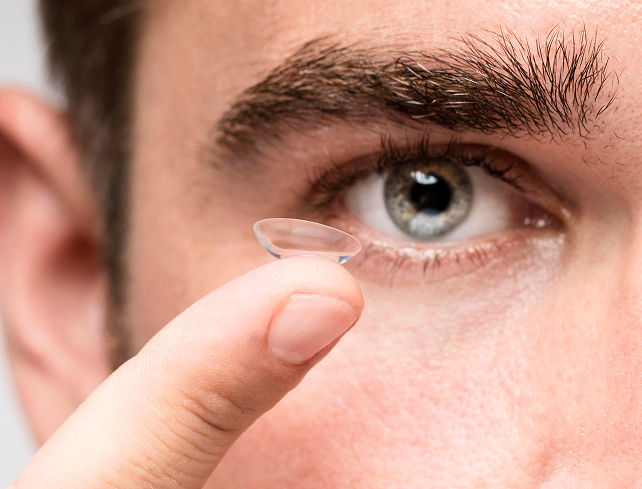
Types of contact lenses
There are many types of contact lenses. An eye care specialist can help you decide which type is best for you. The four main factors you need to consider are:
- Lens material.
- Wear schedule.
- Replacement schedule.
- Special features.
Lens material
Contacts can be either soft or gas permeable (GP). Most people choose soft contacts. Here’s what you should know about each type:
- Soft contact lenses. These are contacts made of flexible plastic. Many people feel they’re comfortable and can quickly adjust to wearing them (within a few days). However, these contacts easily absorb pollutants (like lotion or soap from your hands), which can irritate your eyes. They’re also fragile and may tear or rip.
- Gas permeable contact lenses. Gas permeable (GP) contact lenses, also known as rigid gas permeable (RGP) lenses, are harder than soft lenses. But unlike older versions of hard lenses, RGP lenses are made with silicone polymers. This material is durable while still allowing oxygen to circulate to your cornea. RGP lenses keep their shape better than soft lenses and offer clearer vision for some types of corrections. A drawback is they may be less comfortable than soft lenses when you first start using them. Some people need a few weeks to adjust
Wear schedule
You can choose contacts that are daily wear or extended wear.
- Daily wear. You wear these contacts during the day, but you take them out at night. You should never sleep in daily wear contacts. Doing so raises your risk of an eye infection.
Depending on your replacement schedule, you either throw out the contacts at night or you clean and store them according to your provider’s instructions to reuse the next day.
- Extended wear. These contacts you can wear both day and night (while you sleep). You can keep them in continuously for up to 30 days. The exact length varies based on the person and the specific type of lens. Your provider evaluates your eyes and decides how long you can safely keep them in. After each scheduled removal, you should sleep at least one night without your lenses in to let your eyes rest. Extended wear contacts may raise your risk of eye infections. So, it’s important to discuss your risk with your provider.
Who Should Have This Test?
- Adults & children of all ages
- Those experiencing blurred vision or eye strain
- Patients with family history of eye conditions
- Anyone due for a routine check-up
Replacement schedule
Your replacement schedule is how often you need to replace your contacts. This applies to soft contact lens use only. You wear RGP lenses long-term until your provider determines you need new ones.
There are two main replacement schedules for soft contacts:
- Daily disposable. With this schedule, you wear a new pair of contacts each day. You insert a new pair in the morning, wear them all day and remove them before bed. When you remove your contacts, you throw them out. You should never reuse daily disposables. Doing so can lead to eye irritation or an infection. A daily disposable schedule is ideal if you have allergies. It also lowers your risk of dry eye disease and irritation from contact lens solutions.
- Planned replacement. With this schedule, you wear your contacts all day and remove them before bed. But instead of throwing them out, you clean and store them overnight. With proper care, you may keep using the same lenses for up to 30 days. You should never wear your contacts overnight unless they’re approved for extended wear.
Special features
Some contacts have special features that help manage certain eye conditions or give you added benefits. Some types of contacts that may be appropriate for you include:
- Hybrid contact lenses. These contacts have a durable RGP center surrounded by an outer ring of soft material. Hybrid contacts may be more comfortable for you than RGP contacts while still providing crisp, clear vision. This type may be suitable for people who have irregularly shaped corneas due to astigmatism, corneal ectasia or other conditions.
- Toric contact lenses. Toric lenses are special lenses for people with astigmatism. They’re made from the same material as other contacts and come in soft or RGP forms. Like bifocal glasses, toric lenses have two powers. One is correct for astigmatism, and the other for myopia or hyperopia.
- Multifocal contact lenses. These contacts improve distance and close-up vision at the same time. They’re ideal for people who have both nearsightedness and age-related farsightedness (presbyopia). Each lens has two or more prescriptions (powers) to correct your vision at different distances.
- Scleral contact lenses. Scleral lenses are a form of RGP lenses. The main difference compared with standard RGP lenses is that scleral lenses are larger. So, their edges rest on the white part of your eye (sclera) rather than your cornea. There’s a small gap between the lens and your cornea, which allows your eye to stay lubricated. Scleral lenses help people with dry eye disease and various conditions affecting the cornea.
- Orthokeratology (Ortho-K) contact lenses. These are specialty hard lenses that you wear only while you sleep. They change your cornea’s shape to correct vision problems (usually nearsightedness). Wearing Ortho-K lenses at night can help you have clearer vision for most or all of the next day. Your provider decides how often you should wear your lenses to meet your vision needs.
- Cosmetic (decorative) contact lenses. Cosmetic lenses change the appearance of your eyes. They may also improve your vision, but not always. Some cosmetic lenses simply change your eye color or make your eyes resemble those of an animal or other creature. These can be fun, but only if you recognize the risks. All cosmetic lenses require a prescription even if they don’t change your vision. They also require proper care and usage. Never buy cosmetic lenses from shops that don’t require a prescription. Such sales are illegal in the U.S., and wearing nonprescription contacts may severely damage your eyes. Talk to your provider if you’re interested in cosmetic lenses.
Find Your Perfect Pair of Glasses Today
Convenient, fast, and secure online booking for eye tests, hearing checks, and consultations.